Every direct night is commission you did not pay, and one page shows where guests came from and how much direct booking grew this month.
Back to AI Web Development
Hotels & resorts · 03 / 13
Booking engine on the hotel’s own site
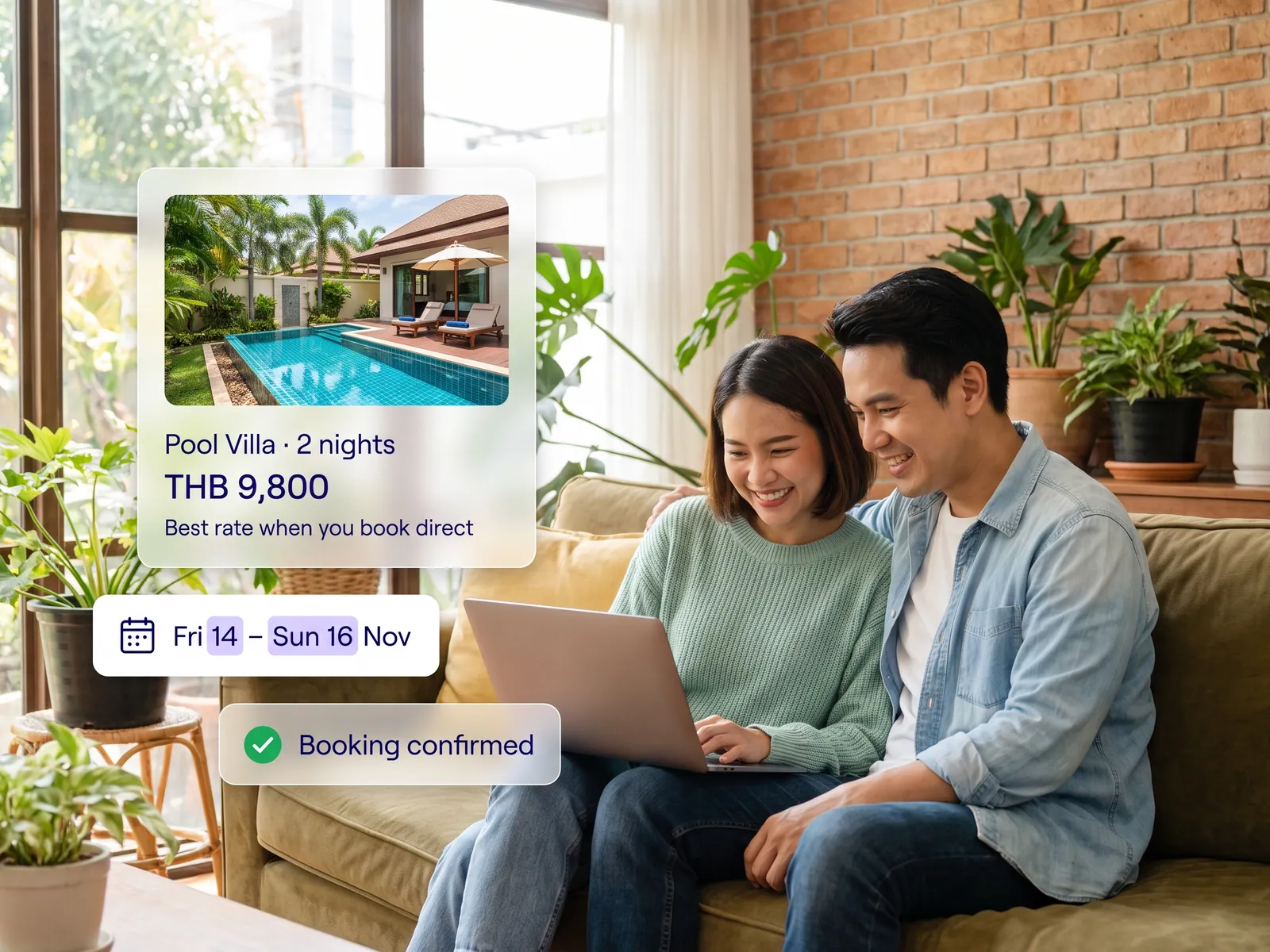
A booking page on the hotel’s own domain with live rooms and rates from the PMS, payment and automatic confirmation, and no OTA commission.
 Hotels & resorts
 “Guests find us on Google, then book through an OTA because our site can’t take bookings. We pay commission on every night from guests who were already looking for us, and when we did open direct booking we ended up confirming by phone.”
The problem
Most guests find a hotel on Google or by asking an AI assistant, then open an OTA to book, because the hotel’s own site either cannot take a booking or takes a form and leaves the guest waiting for a call back. So the hotel pays commission on every night, including nights from regulars who typed the hotel’s name in to find it directly.
Meanwhile the front desk spends the day answering the same questions on LINE and the phone: any rooms, what rate, is there a transfer. When a direct booking does come in, someone keys it into the PMS by hand, and one slip means an overbooking.
How we solve it
We build a booking page on the hotel’s domain connected to the PMS and channel manager you already run. Guests see real availability and rates, pick a room, pay, and get an email and LINE confirmation within a minute. The booking writes itself into the PMS and closes the room on every channel at the same time. Nobody at the desk re-keys it.
AI chat on the site answers the questions the desk repeats every day, in the guest’s language, from information the hotel has approved: check-in time, the airport transfer, the child policy. When the guest is ready it takes them to the booking page. Special requests, an extra bed or a group rate, go to a staff member with the full conversation attached.
Rates, promotions and refunds remain the hotel’s decisions. The system never changes a rate on its own, and a cancellation that involves a refund is approved by staff every time. After go-live we look at the numbers with you each month: how the direct share has moved and which searches bring guests to book.
How it runs
Work comes in from
- Guests from Google and AI assistants
- Availability and rates from the PMS
- Questions in AI chat
- Google Hotel Ads
What the AI does
- Show real availability and rates
- Take payment and confirm
- Answer in the guest’s language
- Pass special requests to staff
Where it lands
- Booking in the PMS
- Confirmation by email and LINE
- Room closed on every channel
- Dashboard of direct vs OTA
Before and after
Before
After
Guests find us on Google, then book on an OTA
Guests book and pay on the hotel’s site, no commission
Direct bookings confirmed by phone and keyed into the PMS by hand
Bookings land in the PMS and close the room everywhere at once
The desk answers the same LINE questions all day
AI chat answers about rooms and transfers through the night
What you get
- 01
A booking page on the hotel’s own domain with live availability and rates from the PMS and channel manager; a booking closes the room on every channel at once
- 02
Card and PromptPay payment with automatic email and LINE confirmation in Thai, English, Chinese, Japanese and Korean
- 03
AI chat that answers about room types, transfers, check-in times and child or pet policies from information the hotel approved, then takes the guest to the booking page
- 04
A hotel page that ranks for its own name, connected to Google Hotel Ads and written so AI assistants cite it when travellers ask
- 05
Pre-arrival and post-checkout messages on LINE or email with a direct-booking code for next time, and a dashboard of direct bookings against OTA
Who gets what
PMS and channel manager connected through official APIs. Payment runs through a certified provider, so card data never touches the hotel’s server. Guest data is stored under PDPA, and we leave your existing systems as they are.
The front desk stops re-keying bookings and stops answering the same questions all day, and keeps only the cases that need a person, like special requests and groups.
Who this fits
Hotels & resortsBoutique hotels & hostelsServiced apartmentsVillas & pool villasHotel groups with several properties
Connects with what you already run
Opera PMSSiteMinderOmiseGoogle Hotel AdsLINE OAGoogle Analytics
Development process
- 1
Discover
Requirements, users and success metrics, with scope and price fixed before we start.
- 2
Design
UX and system architecture; the prototype is approved before anything is built.
- 3
Build
AI-accelerated sprints with a demo every week, reviewed by senior engineers.
- 4
Test
QA, security and performance verified against the agreed scope.
- 5
Launch & care
Production deploy, team training, and a monthly care plan.

Turn your business problem into a system that works for you
Tell us today — get an executive-ready proposal with the plan and budget.
Talk to an engineer about thisMore solutions in AI Web Development
See the whole service Companies & factories Multilingual corporate website Retail & brands Online store on your own domain Service firms & B2B Customer portal Marketing teams & agencies Campaign & landing pages Operations & IT Internal web app Owners & marketing teams AI search visibility (GEO & AEO) Clinics & aesthetics Clinic website with online booking Schools & universities Admissions site and student portal Real estate Project site with viewing appointments Restaurants & cafés Restaurant site with ordering and table booking Factories & wholesalers B2B catalogue and quote requests Tutoring schools & trainers Online course website