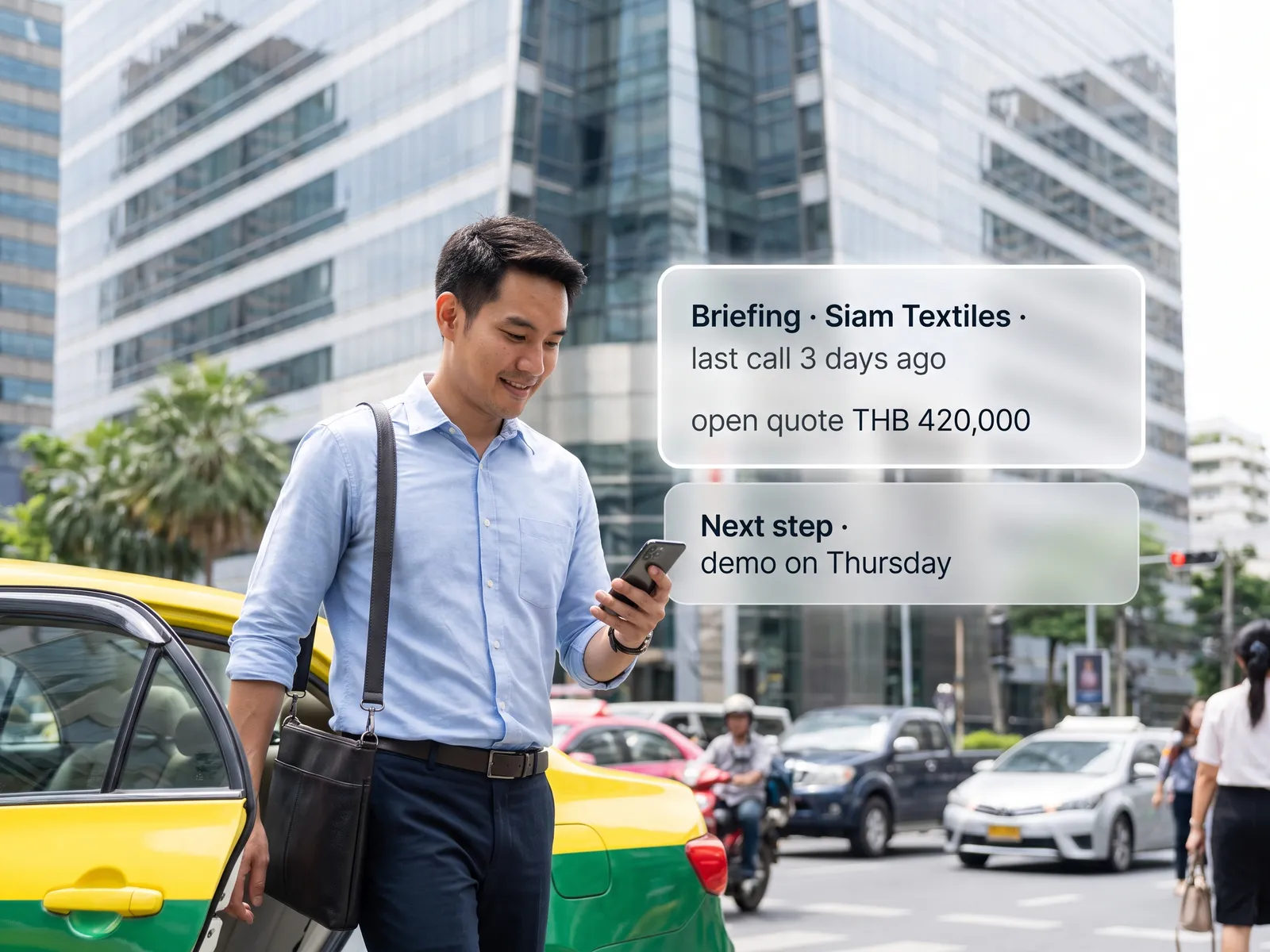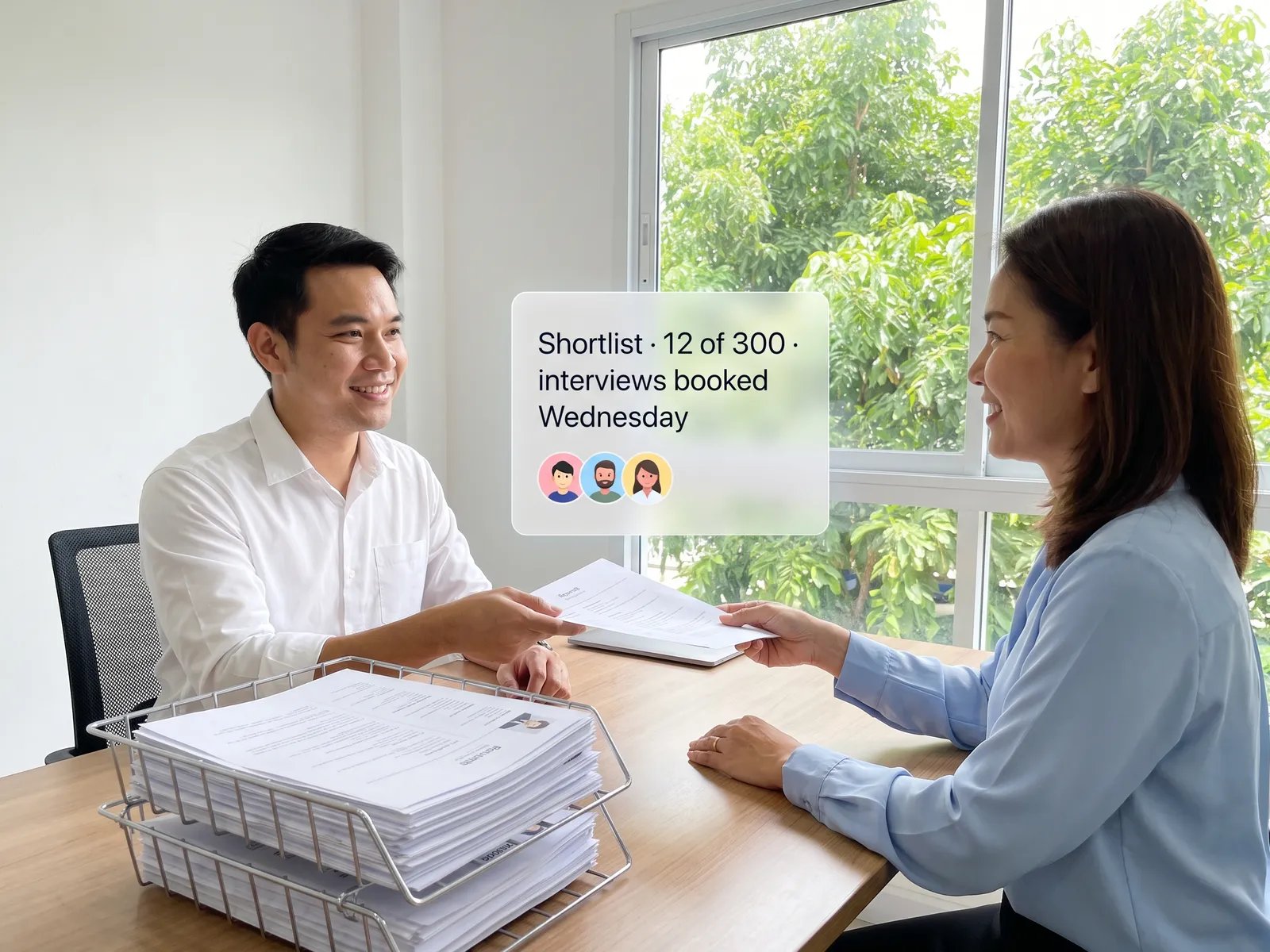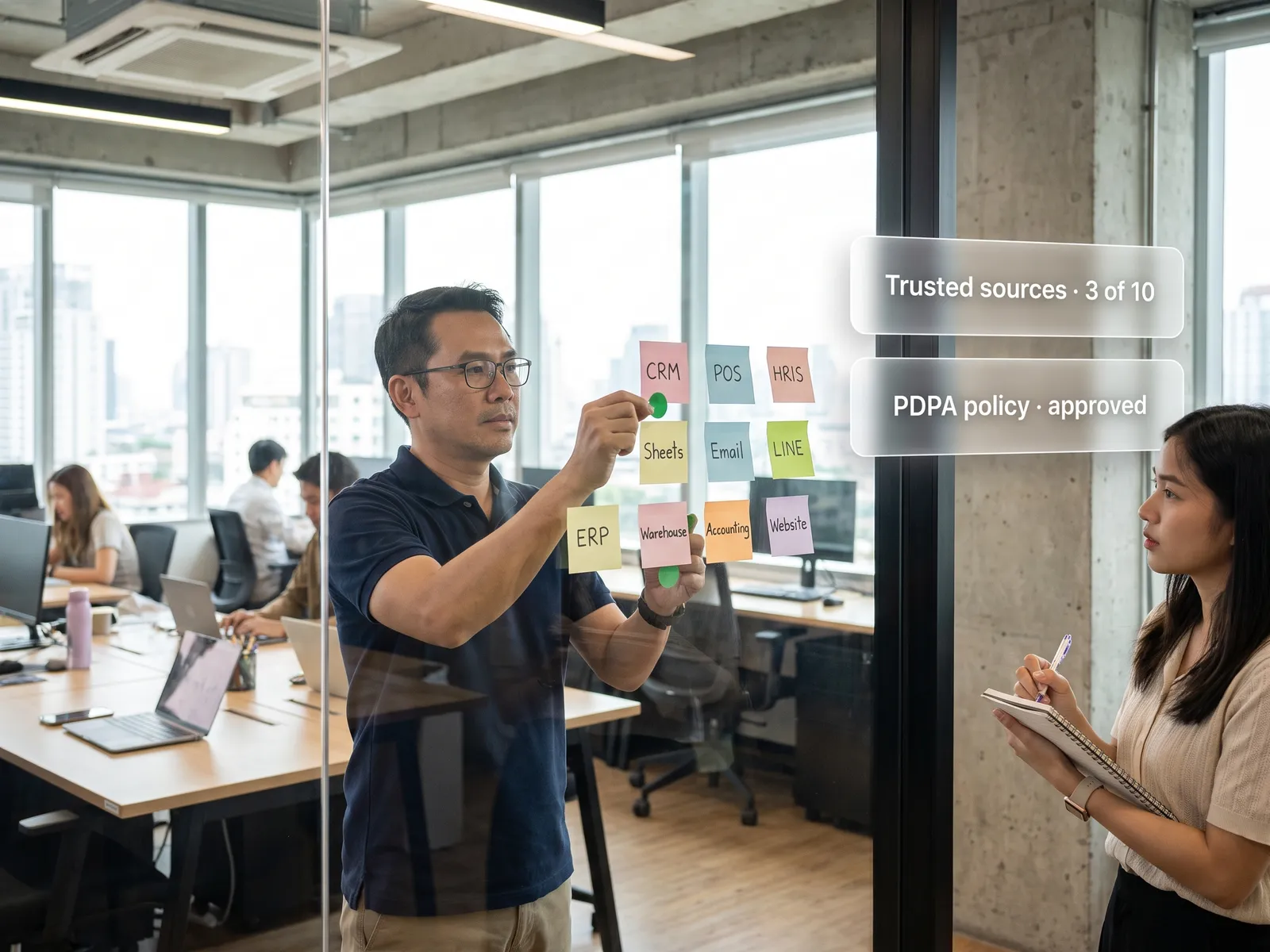
You see which department will use AI for what, you have a policy to show a customer or an auditor who asks, and the licenses you pay for are used on real work.
Back to AI Transformation
HR and executives in charge of training · 08 / 14
In-house AI training for companies
The engineers who build AI systems for Thai banks and hospitals teach your team, using each department’s own documents and work as the exercises. Everyone leaves with prompts for the next day, a draft AI usage policy and a first automation built in the room.
“We bought ChatGPT for the team and sent people on an online course. They came back drafting emails with it and nothing else. One person pasted a whole customer list into it, another won’t touch it, and if you ask which department should use it for what, nobody can say.”
The problem
Most companies start by buying licenses for staff or sending them to a course on using ChatGPT in general. People come back drafting emails faster and little else, because the examples in class were someone else’s work. Faced with their own, a quotation with special terms or a report that has to cite company rules, they don’t know where to start, and nobody has told them how far to trust what the AI says.
What happens quietly is the bigger worry. One employee pastes a whole customer table into a public AI because nobody said not to; another never uses it for fear of doing something wrong. When someone asks the executives whether the company has a policy, the answer is that one is in progress. HR has a training budget and struggles to find a teacher who knows how AI systems work and also understands what accounting or purchasing does all day.
How we solve it
The people who teach are our engineers, the ones building AI agents, automation and Private LLMs for Thai banks, hospitals and large groups every day. They can explain how a language model works, why it sometimes answers wrongly with full confidence, and where the data you type travels. Before the training we ask each department for the real documents it uses, a quotation form, a product manual, the leave rules, a monthly report, with personal data removed, and turn them into the exercises. Everyone practices on the work waiting for them on Monday.
The class runs in-house. The content uses the tools you already pay for, whether that is ChatGPT, Microsoft 365 Copilot, Gemini in Google Workspace or Claude, and every class has a session where we write the AI usage policy together: which kinds of data may go in, how personal data is masked under PDPA, and which work a person checks before it is used.
Before the class ends, the team builds a small first automation together on the company’s own account, such as n8n reading customer request emails and summarizing them into Google Sheets, or drafting answers to LINE OA questions for a person to send. It shows how short the distance is between typing a prompt and a system that works on its own. After the training, the team sends the work they tried to our engineer in a follow-up clinic, and keeps a prompt set per department and a short guide HR can use to train new staff. When the team is ready to go further, our forward deployed engineers come in and build use cases on the real systems.
How it runs
Work comes in from
- Each department’s real documents and work
- The AI licenses your company already has
- The questions the team got stuck on
- The executives’ concerns about data and PDPA
What the AI does
- The engineer explains how AI works and where it fails
- Each person tries it on their own tasks
- The policy is drafted together on the whiteboard
- The first automation is built together
Where it lands
- A prompt set per department
- A draft AI usage policy
- A first automation that works
- A short guide and a follow-up clinic
Before and after
Before
After
Staff go on a general course and come back using AI to draft emails
Each department has prompts for its own work, in use from the next day
Nobody has said whether customer data may go into AI, so everyone guesses
A one-page policy everyone knows: what may go in, what is masked first
The know-how sits with the few who tried on their own, and leaves when they do
The prompt set and guide belong to the company, and HR trains new staff itself
What you get
- 01
An executive session where the owner and department heads see what AI can and cannot do with your company’s work, then decide which team starts first, which data never leaves the company and who owns the policy
- 02
A workshop per department, for sales, accounting, purchasing, HR or customer service, where each person works on their own tasks in the ChatGPT, Copilot or Gemini your company already uses: drafting a quotation from an old one, summarizing a long report, answering a customer from the company manual
- 03
A draft AI usage policy written together in the room: which kinds of data may go into which tool, what to do with customer and personal data under PDPA before using it, which work a person checks before it goes out, and who to tell when something goes wrong
- 04
The first automation the team builds itself in the room with our engineer, such as summarizing customer emails into Google Sheets or drafting replies to LINE OA questions with n8n on the company’s own account, with notes on how to extend it
- 05
A follow-up clinic after the training, where the team sends the work they tried and gets prompts and fixes back, plus a prompt set per department and a short guide HR can use to train new staff
Who gets what
The engineer who teaches knows where data goes when staff type it into AI, so access, masking personal data and prompt injection are taught together. The automation built in the room sits on the company’s own account, where IT can see it and switch it off at any time, and when data cannot leave the company we walk through the Private LLM option.
They try it on their own work with an engineer beside them who can say at once why the answer came out that way, go back with prompts that work, and know what is allowed and what is not, so there is nothing to be afraid of.
Who this fits
Companies that have bought ChatGPT, Copilot or Gemini licenses for staffOrganizations about to take their first AI system into useHR and L&D teams with an annual training budgetExecutives who must issue an AI usage policy under PDPAForeign-owned companies in Thailand training Thai staff in Thai
Connects with what you already run
ChatGPTMicrosoft 365 CopilotGemini in Google WorkspaceClaudeGoogle WorkspaceMicrosoft 365n8n
Development process
- 1
Discover
Requirements, users and success metrics, with scope and price fixed before we start.
- 2
Design
UX and system architecture; the prototype is approved before anything is built.
- 3
Build
AI-accelerated sprints with a demo every week, reviewed by senior engineers.
- 4
Test
QA, security and performance verified against the agreed scope.
- 5
Launch & care
Production deploy, team training, and a monthly care plan.
Read moreForward Deployed Engineers (FDE) for AI adoptionAn AI usage policy your staff will follow, and what Thailand's PDPA asks of itAI use cases in business, by department: sales, accounting, purchasing, HR10 skills employees need so AI doesn't leave them behindA 12-month plan to reskill your whole company to work alongside AI

Turn your business problem into a system that works for you
Tell us today — get an executive-ready proposal with the plan and budget.
Talk to an engineer about thisMore solutions in AI Transformation
See the whole service Executives & finance AI roadmap for executives and finance Sales teams AI roadmap for sales Operations & production AI roadmap for production and operations HR teams AI roadmap for HR Marketing teams AI roadmap for marketing IT & data AI roadmap for IT and data Organisations rolling out AI Forward Deployed Engineers (FDE) for AI adoption Factories & manufacturers AI roadmap for a factory Hospitals & clinic groups AI roadmap for healthcare providers Banking, insurance & securities AI roadmap for financial institutions Multi-branch retail AI roadmap for retail Logistics companies AI roadmap for transport and warehousing Family businesses & SMEs AI roadmap on a limited budget