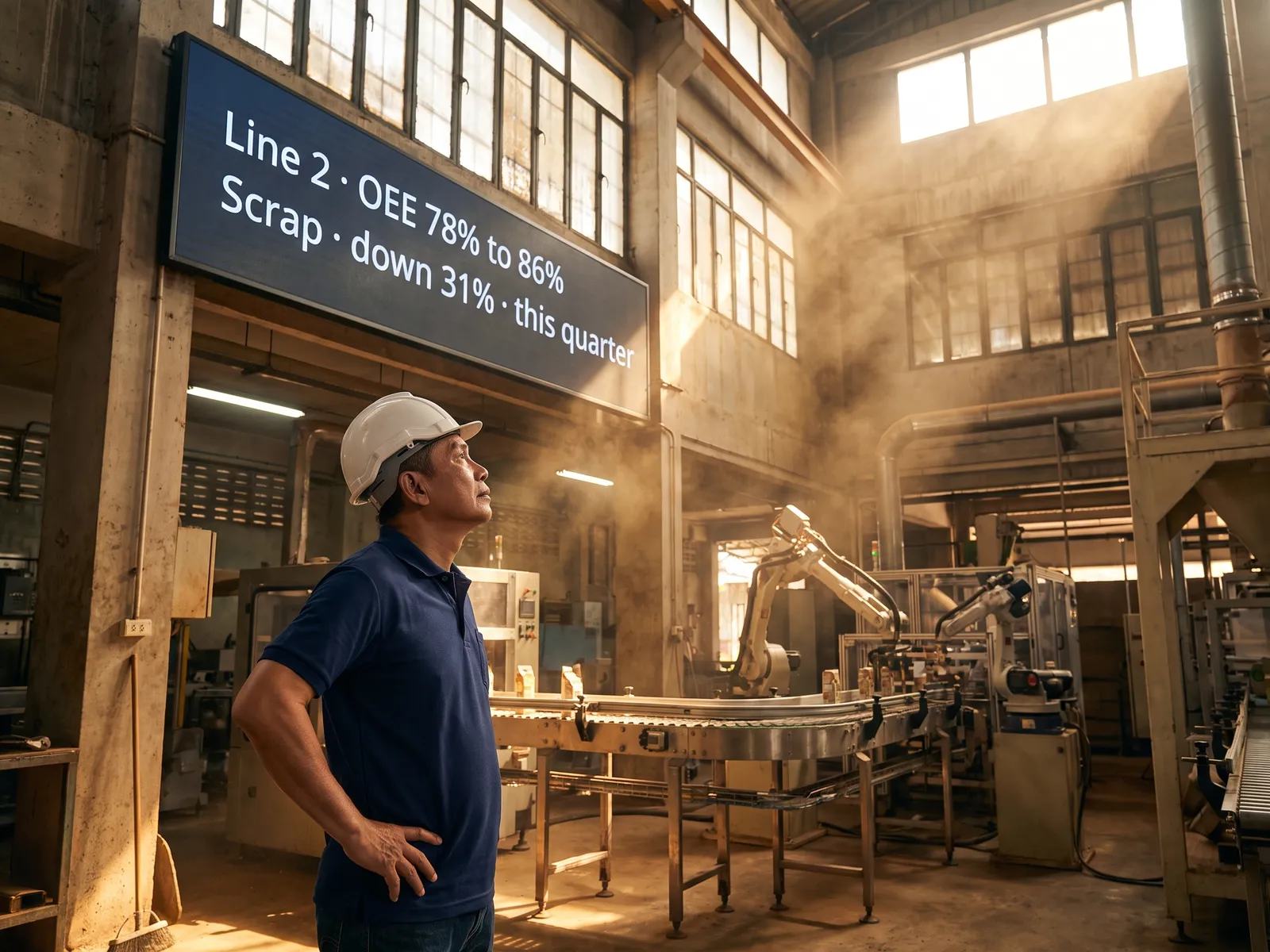
A number for how many extra hours the line ran after the start, and the next investment decided on the first machine’s result instead of a vendor’s slides.
Back to AI Transformation
Operations & production · 03 / 13
AI roadmap for production and operations
Start AI with the one machine that stops most often: use the sensor data you already collect to warn before it fails, and measure the result in line hours.
 Operations & production
 “We find out a machine is failing when it has failed. The line stops for a day. The sensor data exists; nobody looks at it.”
The problem
Many factories already have the sensors. Temperature, vibration and current readings flow into SCADA every second, and that is where they stop: on a screen in the control room that nobody looks back at until a machine fails. Repair history sits in the maintenance team’s notebook or in an Excel file that has never been laid next to the sensor readings.
So machines fail when nobody expects it. The line stops for a day while parts arrive, orders slip, and management hears Industry 4.0 pitches from tool vendors without anyone able to say what the data already on hand could do.
How we solve it
We start by walking the line with the production lead and the maintenance team: which machine stops most often, how it fails and what the sensor readings looked like before the last failures. Then we say plainly whether the history you have is enough to predict failures or needs more collecting first. If it does, the roadmap says what to install where and how many months to wait.
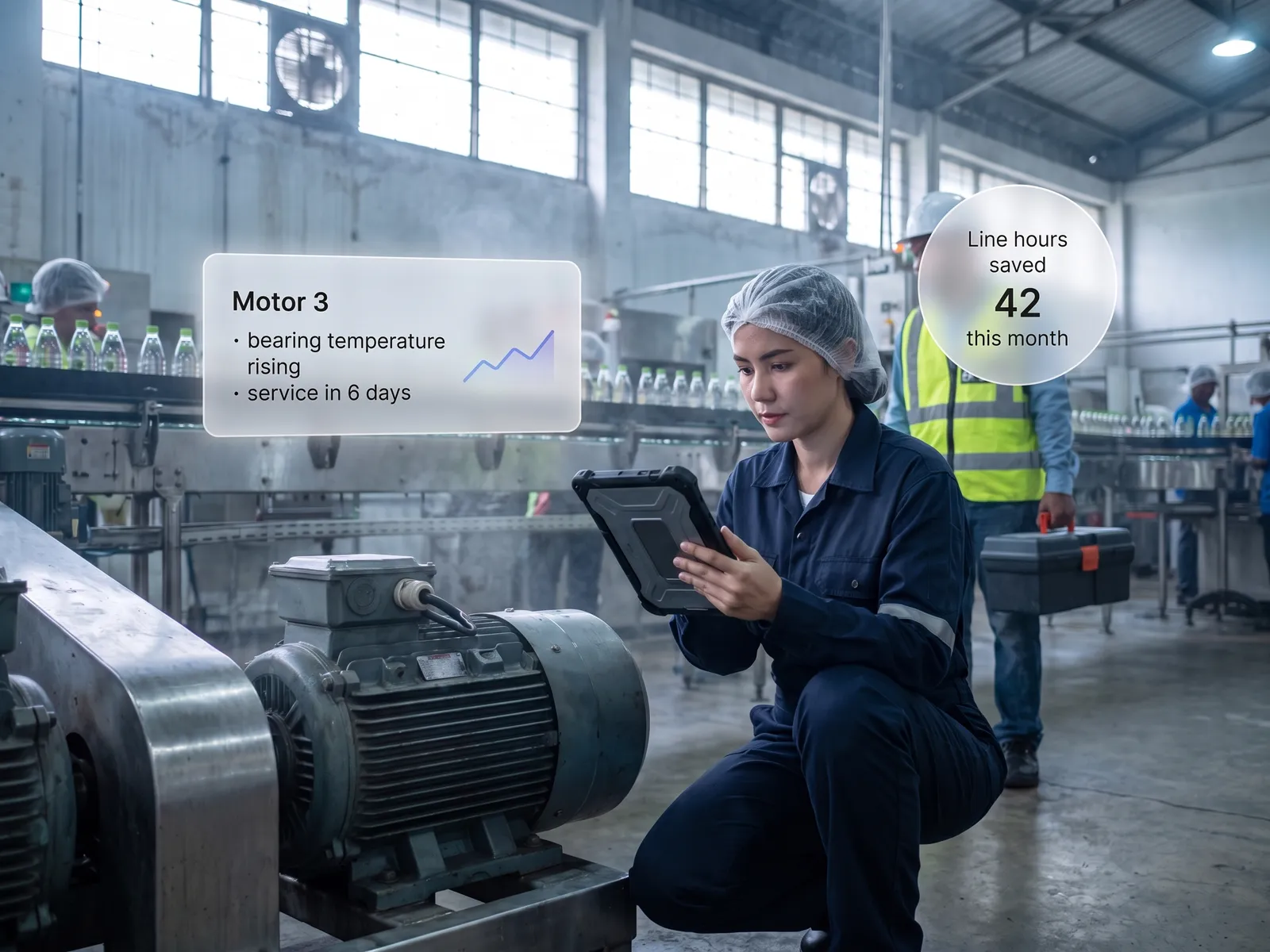
The first system we build together watches one machine. It reads SCADA values, compares them with the patterns seen before earlier failures, and alerts maintenance on LINE when a reading drifts out of its normal range, naming the value and the machine. The team schedules the repair for a planned stop instead of an emergency mid-shift.
Stopping a machine or moving the production plan stays a supervisor’s decision. The system warns and informs. We measure line hours and the number of emergency stops against the months before, and move to the next machine once the first one shows a clear result.
How it runs
Work comes in from
- Sensor values from SCADA and PLCs
- Repair history from CMMS or the logbook
- Plan and output from MES or ERP
- Walking the line with production and maintenance
What the AI does
- Assess how far the data can predict
- Rank use cases by payback
- Deliver the 90-day roadmap
- Build the first machine’s warning together
Where it lands
- Alerts to maintenance on LINE
- Machine health dashboard for the plant manager
- Sensor plan for the next phase
- A maintenance team that runs it from here
Before and after
Before
After
You learn a machine has failed when the line is already down
Maintenance gets a LINE alert before the failure and repairs during a planned stop
Sensor data is recorded every second and never opened
Sensor readings and repair history side by side on one screen
Industry 4.0 tools bought, nobody sure where to start
One machine with a measured result, and a plan for which comes next
What you get
- 01
An assessment of your machine data: which sensors record what, how many months of history exist, and whether the repair records are enough to predict failures yet
- 02
A list of production use cases ranked by payback, such as failure warnings, camera inspection, production planning and shop-floor output logging
- 03
A 90-day roadmap that picks one machine or one line to start with, says where extra sensors are needed and how the result is measured
- 04
The first system, built together: an early warning for the machine that stops most often, reading sensor values and repair history and alerting maintenance on LINE when readings drift
- 05
A rule on who decides to stop a machine or change the plan, and a workshop so line supervisors and maintenance read the results and run the system themselves
Who gets what
We read SCADA or PLC values through OPC UA or the historian, read-only, without touching the control loop. It can run inside the plant network if policy keeps data on site.
Maintenance stops running to emergency repairs mid-shift, and line supervisors know at the start of the week which machine to watch.
Who this fits
Food and beverage plantsAutomotive parts and electronicsPackaging and plasticsBuilding materialsPlants with several continuous lines
Connects with what you already run
SCADAPLC and IoT sensorsMESERPCMMSPower BI
Development process
- 1
Discover
Requirements, users and success metrics, with scope and price fixed before we start.
- 2
Design
UX and system architecture; the prototype is approved before anything is built.
- 3
Build
AI-accelerated sprints with a demo every week, reviewed by senior engineers.
- 4
Test
QA, security and performance verified against the agreed scope.
- 5
Launch & care
Production deploy, team training, and a monthly care plan.

Turn your business problem into a system that works for you
Tell us today — get an executive-ready proposal with the plan and budget.
Talk to an engineer about thisMore solutions in AI Transformation
See the whole service Executives & finance AI roadmap for executives and finance Sales teams AI roadmap for sales HR teams AI roadmap for HR Marketing teams AI roadmap for marketing IT & data AI roadmap for IT and data Organisations rolling out AI Forward Deployed Engineers (FDE) for AI adoption Factories & manufacturers AI roadmap for a factory Hospitals & clinic groups AI roadmap for healthcare providers Banking, insurance & securities AI roadmap for financial institutions Multi-branch retail AI roadmap for retail Logistics companies AI roadmap for transport and warehousing Family businesses & SMEs AI roadmap on a limited budget