The first AI project leaves the lab and reaches real staff, and management can tell the board and the auditors exactly how it is controlled.
Back to AI Transformation
Banking, insurance & securities · 10 / 13
AI roadmap for financial institutions
Design use cases with compliance from day one, start with low-risk back-office work, and scale on evidence your auditors accept.
 Banking, insurance & securities
 “Data and budget are not the problem. Every project stalls on compliance and risk, so nothing ever leaves the lab.”
The problem
Financial institutions hold more data than anyone and have had AI budgets for years, yet every project walks up to compliance and stops, because nobody can answer which customer data the model sees, who is accountable for a wrong answer and what an auditor could inspect afterwards. The innovation team builds handsome prototypes in the lab and none of them reach the staff who do the work.
Meanwhile some staff have started using public AI tools to summarise customer documents themselves, because it is faster. That is a bigger risk than the project that never started.
How we solve it
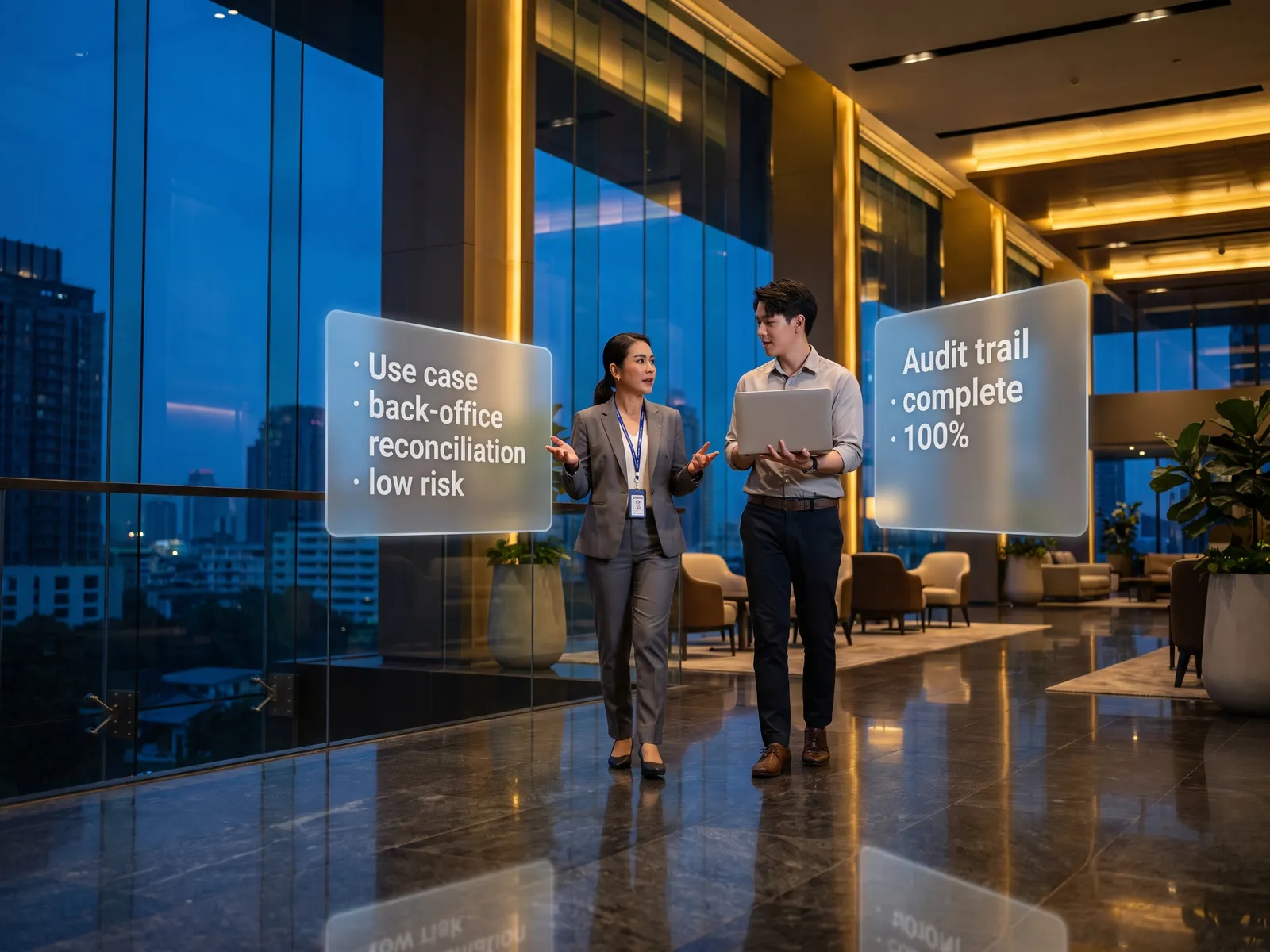
We bring compliance and risk into the first meeting and pick use cases from low-risk back-office work where the data already sits inside the building: reading account-opening documents for staff to check, summarising claims files for the assessor, or answering staff questions on internal rules. The governance framework is written together and states what data the model may use, which system it runs on and where a person must check.
The pilot is built together with one team. Every answer the system gives records which documents it drew on, so an auditor can look back at any of them, and we measure the result in paperwork hours saved and the errors the checkers catch. That is the evidence compliance uses to approve the next phase.
Credit approvals, claim payments, investment decisions and anything else that touches a customer’s money stay with authorised staff. The system reads, summarises and prepares. If policy says customer data cannot leave your systems, the model can run in your own data centre.
How it runs
Work comes in from
- Customer documents and core banking
- Internal rules and regulatory requirements
- Proposals from innovation and the branches
- Meetings with compliance and risk
What the AI does
- Assess the data and the rules that apply
- Design use cases with compliance
- Deliver the governance framework and roadmap
- Pilot with one team, every answer logged
Where it lands
- A system back-office staff use for real
- Evidence to approve the next phase
- A governance framework auditors accept
- A compliance team that assesses the next project
Before and after
Before
After
Handsome prototypes in the lab, none in the hands of staff
A first system in daily use with one team, with the numbers to scale on
Compliance sees the project when it is finished, and stops it
Compliance co-designs from day one and approves on evidence
Staff quietly use public AI on customer documents
An in-house tool that works within the framework, every answer logged
What you get
- 01
An assessment of your data and systems, with the regulatory requirements and PDPA conditions that bear on each use case
- 02
A list of use cases designed with compliance, starting with low-risk back-office work: reading account-opening documents, summarising claims, answering staff questions on internal rules
- 03
An AI governance framework that states what data a model may use, where it lives, where a person must check and what is recorded for auditors
- 04
A 90-day roadmap with the budget, team, metrics and the evidence each phase must produce for compliance to approve the next
- 05
A pilot built together with one team, with an audit log of every answer, and a workshop so the compliance team reads the results and assesses the next project itself
Who gets what
Read-only connections to core banking and the document systems through existing channels. The model runs in your data centre or in a cloud you have already assessed, signs in through Active Directory and logs every question.
Back-office staff get documents already read and summarised for checking, and stop paging through files by hand.
Who this fits
Commercial banksLife and non-life insurersSecurities and asset management firmsLeasing and consumer financePayment providers
Connects with what you already run
Core bankingInsurance and claims systemsMicrosoft 365Active DirectoryPower BIPrivate LLM
Development process
- 1
Discover
Requirements, users and success metrics, with scope and price fixed before we start.
- 2
Design
UX and system architecture; the prototype is approved before anything is built.
- 3
Build
AI-accelerated sprints with a demo every week, reviewed by senior engineers.
- 4
Test
QA, security and performance verified against the agreed scope.
- 5
Launch & care
Production deploy, team training, and a monthly care plan.

Turn your business problem into a system that works for you
Tell us today — get an executive-ready proposal with the plan and budget.
Talk to an engineer about thisMore solutions in AI Transformation
See the whole service Executives & finance AI roadmap for executives and finance Sales teams AI roadmap for sales Operations & production AI roadmap for production and operations HR teams AI roadmap for HR Marketing teams AI roadmap for marketing IT & data AI roadmap for IT and data Organisations rolling out AI Forward Deployed Engineers (FDE) for AI adoption Factories & manufacturers AI roadmap for a factory Hospitals & clinic groups AI roadmap for healthcare providers Multi-branch retail AI roadmap for retail Logistics companies AI roadmap for transport and warehousing Family businesses & SMEs AI roadmap on a limited budget