
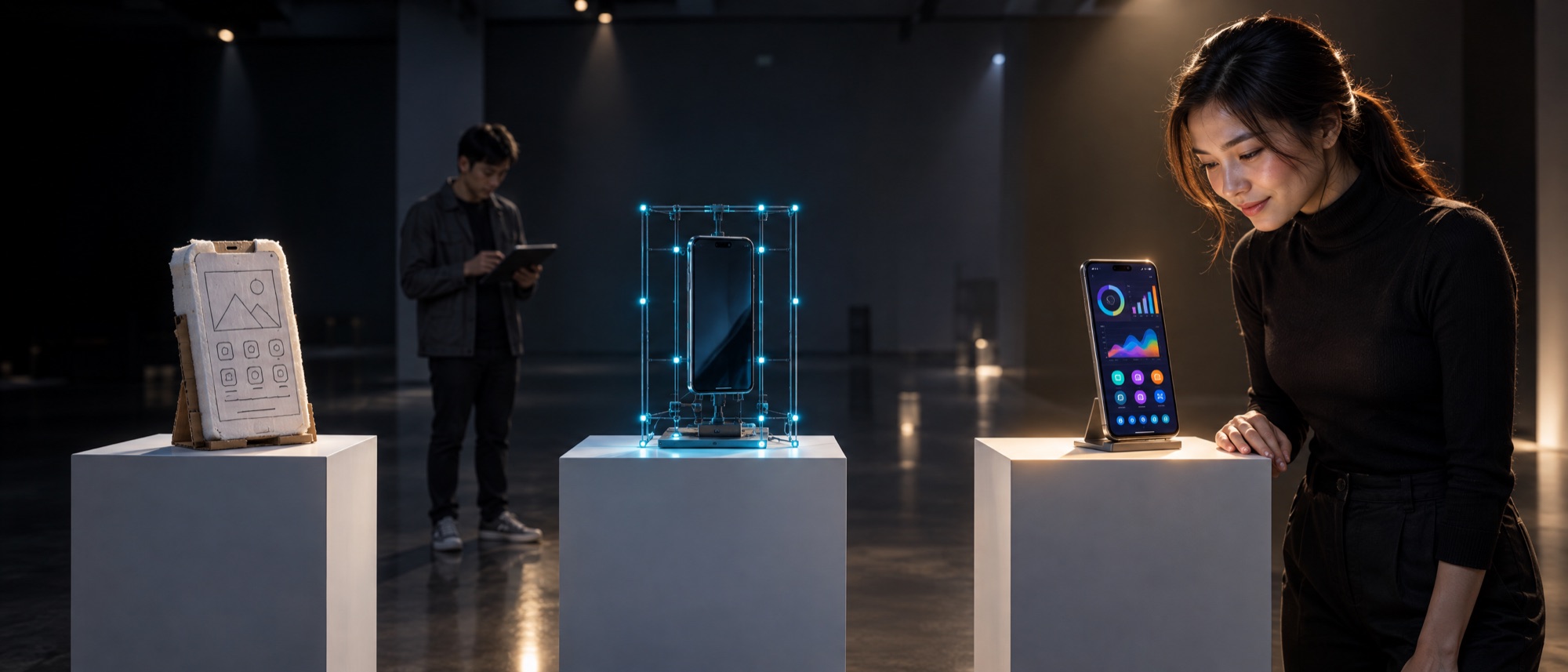
Got a startup idea but no developers?
Don't let your idea stay in your head.Every big business started as a small idea, but not everyone has a technical team ready to make it real. You might have an idea for a new app, a website that stands apart from competitors, a customer platform, or a system that makes a business easier to run. DNA Maker builds MVPs, web apps and mobile apps for startups, with our own engineers in Bangkok and no subcontractors.
The questions come next
Five things every founder has to answer before building, with short answers from our team.
-
Where do I start?
Start by telling us what problem your customers have and how you want to solve it. An idea is enough. We turn it into requirements, user flows and a development plan. If the business model is still open, build a Business Model Canvas with Dream right now.
-
What technology do I need?
We pick it from your business model and how your users behave. Some ideas only need a web app; others need iOS and Android apps, or a LINE Mini App that customers open without installing anything. We use tools that other teams can maintain, so your business is never tied to one vendor.
-
How many developers do I need?
None to start with. Our team covers design, engineering and project management, and everyone works for DNA Maker; we don't subcontract. When you are ready to hire your own team, we hand over the source code and documents per the scope in the contract so they can take it from there.
-
How much budget do I need?
It depends on the number of features, the systems to connect and the security level you need. An MVP cut down to the essentials costs less than building everything at once. We fix the scope and price before work starts, and for large projects we always offer a smaller first phase. Read what decides the cost of a website or app, or tell Dream your idea for an estimate.
-
How can I be sure it will be secure and able to grow?
We design access rights, backup and recovery, and room to scale from the start. Every change goes through code review and testing before it reaches production. See our development standards and what the screen doesn’t show below.
DNA Maker can be your technology team, from the first idea to the day your business is ready to grow.
You don’t need an IT team to start a startup
We believe founders should spend their time on what they do best: understanding customers, building the business and shaping the product.
For the technology, let us be the team that thinks it through, plans it and builds it with you.
Tell us about your ideaFrom an idea to a product people use
Six steps we take with you. Start at whichever one your business is at today.
- 01 Idea to Product
Turn the idea into a plan you can build
An idea is enough to begin. We turn it into requirements, user flows, a product roadmap and a clear development plan.
- 02 MVP Development
Build only what you need, then test it with customers
You don’t need every feature on day one. We help you pick the essentials and build an MVP you can test with real customers.
- 03 Web & Mobile Application
Web apps, mobile apps and platforms
Web applications, iOS, Android, SaaS platforms, membership systems, marketplaces and digital services that fit your business model.
- 04 Business System & Automation
The back office the business runs on
CRM, ERP, booking, inventory, dashboards, payment integration and automation to support day-to-day operations.
- 05 AI Integration
Put AI inside the product
Add AI chatbots, AI agents, document AI, intelligent search and AI workflows to your product, for new experiences and new capabilities.
- 06 Scale & Maintenance
Ready for more users
As the business grows, we keep developing the system, set up the infrastructure, look after security and monitoring, and get it ready for heavier use.
AI can build apps now. Why hire professional developers?
AI has already changed how software gets made. People who have never written code can build web pages, try out features or make a prototype far faster than before.
We don’t see AI as a competitor; we use it to develop faster. But getting an app to work and building a system a business can rely on are still two different things.
What the screen doesn’t show
Behind every app there is more than the look and the buttons.
- Who can see which data?
- Will it hold up when many people use it at once?
- If someone attacks the API or tries to steal data, what stops them?
- If the database is damaged, can the data be restored?
- When you need new features in two years, how easy will that be?
- If the developers change, can the system be handed to a new team?
We deal with these when we design the system, not after something goes wrong.

Already have a prototype made with AI?
If you or your team built a prototype with AI tools, you don’t have to throw it away. We start by reviewing the code and how it stores data, then tell you plainly which parts can be built on and which should be rewritten before customers use it. After that we set the scope and price like any new project. Read more in from vibe-coded prototype to production system.
More than a team that writes code: a partner who thinks about the business
A startup’s goal isn’t to have an app. It’s to build a business that customers want to use and will pay for. So we start by understanding the business problem, then choose the technology that fits.
- If a feature isn’t needed yet, we help you set priorities.
- If an idea should be tested before a full investment, we help you plan the MVP.
- And when your business is ready to grow, we help the system grow with it.
Tools for founders to try before you talk to us
Estimate a budget, lay out the business model and see what competitors are doing. Each tool gives you a document to keep.
Cost Estimator
Pick a project type, see a realistic price range instantly.
Estimate nowAI Business Model Canvas
Answer 5 questions, get a full BMC with AI-opportunity notes as a PDF.
Generate BMCAI Competitor Check
Say what you sell and where. AI searches the web for your competitors and shows where you can lead, as a PDF.
Check competitorsA team that has built new products before
Our team has delivered more than 500 projects, from systems for large organisations to new digital products, such as the design of an AI virtual try-on app for Wearly and the auto-parts ordering app for CarPAS. We also build Bluweo School Plus, our own school management system, so we know what it takes to keep a product useful for years.
FAQ: MVP and app development for startups
What is an MVP, and why should a startup start with one?
An MVP (minimum viable product) is the first version of a product, with only the features needed to solve the customer’s main problem, so real users can try it as soon as possible. You find out whether customers really want it and will pay before you spend on every feature. The rest can come in later phases, based on what users teach you.
I have no technical background. Can I still start?
Yes. Tell us in business terms: who the customers are, what problem they have and what the system should do for them. Our team turns that into requirements and screens you can review before development starts. Along the way you see a demo every week, so you decide based on something you can see.
How long does an MVP take?
It depends on the number of features. A small web app takes about 4–8 weeks. Larger projects are split into phases, and the date of each phase is in the quotation before work starts. We work in sprints with a demo every week.
Will my idea be kept confidential?
Every project runs under NDA, and systems are designed for PDPA compliance from the start.
Who owns the source code?
We hand over the source code and documents, such as system documentation, the deployment guide and API docs, per the scope in the contract. You can keep us on, or have a team you hire take it from there, so there is no vendor lock-in.
AI can build an app for me. Do I still need developers?
A prototype made with AI is good for testing an idea and showing it to investors or customers. Before it holds real customer data or takes payments, it needs access rights, API protection, backups and code other people can maintain. Read security for vibe-coded apps, or send us the prototype to review first.
Who looks after the system after launch?
The same team that built it. The people who hear your brief on day one are the ones who review the code and look after the system after launch. As users grow, we adjust the infrastructure and build the next phase of features.
Read moreThe 7 steps of app developmentWhat decides the cost of a website or appHow to choose a software houseApp development FAQ
You focus on the business. We look after the technology.
Tell us about your idea. Our engineers will reply with an approach, a first scope and what belongs in the MVP.
Tell us about your idea