
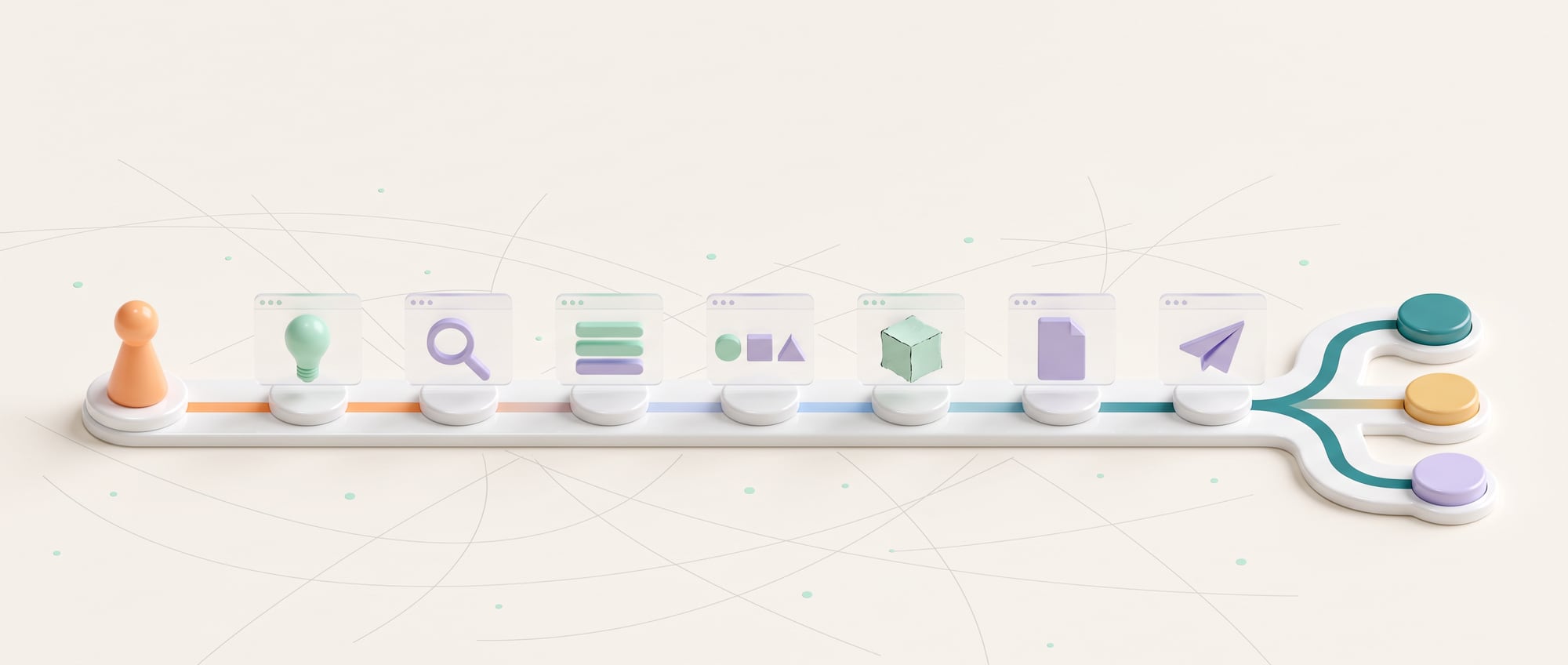
- The goal of the week is evidence of whether people really want the product. A finished product can come later.
- Credible evidence is people leaving their phone number, paying a deposit or booking a call. Compliments on the idea don't count.
- If the result shows nobody is interested, that is a success too, because you have just saved several hundred thousand baht.
1. The 7 days are for evidence, and polish can wait
The most expensive part of launching a new product is rarely the development cost. It is spending six months building something nobody wants. This week exists to answer one question, whether people really want it, before anything gets built.
Traditional product development starts with ideation meetings, then a plan, a budget, design and production, and only after all that does it meet customers. The problem is that the company learns slowest at exactly the point where costs are highest. AI shortens the research, synthesizes options, and produces copy, images, prototypes and test materials, so the team gets in front of customers sooner. What AI cannot do is confirm demand on behalf of real customers.
Before the Sprint starts, write the hypothesis in one sentence: "We believe [which customer group] has [what problem] and is willing to [pay/sign up/try it] to get [what result]." Pick the single biggest risk, for example that customers don't care about the problem, don't believe the offer, or find the price wrong, and design the experiment to find the answer.
2. Day 1: narrow the problem and the customer enough
A common mistake is to choose too broad a customer group for fear of missing an opportunity. A broad group makes the offer so bland that nobody feels it is talking to them.
Gather the voice of the customer from sales conversations, reviews, support tickets, search terms and reasons for not buying. Let AI help categorize them and count the recurring patterns, but the team must read the original examples so the context isn't lost. Choose a problem that happens often, has a clear impact, and that the company has an advantage in solving.
Build a Customer Snapshot that describes the situation, the current process, the cost of the problem, the solution they use now and why it falls short. Avoid broad personas such as "SME owners aged 30 to 50". Use a group you can actually reach, such as "online store owners with more than 1,000 orders a month and at least three admins answering order status questions".
- A one-sentence hypothesis
- A target customer defined by behavior, with demographics used only as a supporting filter
- At least 20 pieces of evidence from real customers
- The riskiest question the Sprint has to answer
3. Day 2: research the market fast without getting lost in pretty data
Have AI help compile the competitors, the alternatives customers use, prices, features and sales messages, then check the source and the date every time. Skip the 50-page market report. The goal is to find out whom customers already pay, which gaps have evidence behind them, and what the company shouldn't copy.
Interview five to eight customers about their past behavior. Don't ask "Would you buy this if it existed?", because people tend to answer politely. Ask when the problem last happened, how they solved it, how much time and money it took, who approved it, and what is stopping them from changing. Let AI help transcribe and summarize after the interviews, but the product owner should sit in on them in person.
| What you need to know | Strong evidence | Weak evidence |
|---|---|---|
| Does the problem matter? | Customers are losing real money, time or opportunities. | Customers say it's "interesting". |
| Is there a budget? | They have paid before, or there is a budget owner. | They think they could probably get one approved. |
| Will they switch? | They agree to meet, try it or leave their details. | They like a survey post. |
4. Day 3: create offers and alternative prototypes
Create three Value Propositions that are genuinely different, such as cutting costs, increasing speed or reducing risk; small tweaks to the ad copy don't count. Let AI help break down the outcomes, features and objections, but have the team choose based on the data from days one and two.
Build the lowest-fidelity prototype that can still answer the question. To test messaging, use a Landing Page. To test a process, use clickable screen images. To test the result, have the team deliver the service manually behind the scenes and present it as if it were automated. This Concierge approach proves the value before you build the full technology.
5. Day 4: build the test product and set its scope
Write clear lists of what you "must have for the test" and what you are "not doing yet". The test product should complete one main path from start to finish. It doesn't need user accounts, a dashboard, lots of settings or integrations with every system. If the team can do some steps by hand during the test, do them by hand to buy speed.
Use AI to help create UI text, FAQs, a trial guide, sample data sets and test cases. For a physical product, use renderings, packaging mockups, a draft formula or specification, and a small-batch production plan. If health, financial or safety regulations apply, have experts check; AI cannot be the one that certifies anything.
Set the metrics before customers see anything, such as form completion rate, call booking rate, number of pre-orders, the price people accept, or how soon testers come back to use it again. Without criteria, the team will read every kind of feedback as support for the original idea.
6. Day 5: build a sales page that really measures interest
The sales page should answer five questions: who it is for, what problem it solves, what result it delivers, how it works, and what to do next. Use language from real customers and show before-and-after examples or results. Don't lead with the word AI if technology isn't the reason customers buy.
Create a Call to Action whose Commitment matches how ready people are, such as booking a call, leaving their details to receive a sample, paying a deposit or pre-ordering. Asking only for an email address, which costs the visitor nothing, gives a weaker signal than getting someone to hand over business data or pay money. You will get fewer conversions, but the evidence is of much higher quality.
AI can quickly produce message versions for each segment, invitation emails and a sales script, but keep its claims under control. Never invent customer numbers or results that have no evidence behind them, and have the owner check that every promise can really be delivered.
7. Day 6: take the offer to customers instead of waiting for Organic Traffic
Contact the target group directly through existing customers, your network, partners or lists you have permission to use. Send short messages that refer to the problem and ask for an action. Leave out long articles and full explanations of the technology. The aim is to get people to see the prototype and make a decision.
For each test, record the group, the message, the channel, the behavior and the reasons people said no. AI can summarize the patterns during the day so you can adjust the next round, but don't change several variables at once, or you won't know what worked. If interested people keep misunderstanding the offer, fix the message before adding features.
8. Day 7: decide without falling in love with the idea
Gather the behavior and the comments, and sort the feedback into the problem, the offer, the price, trust and obstacles. Use the Scorecard you set up in advance, and don't treat the number of compliments as a stand-in for demand. If people are interested but won't take the next step, the problem may not be urgent or the Commitment you asked for may be too high, so you need to run a test to separate the two causes.
There are three possible decisions: go ahead when there is behavioral evidence and you can deliver; adjust when the problem is clear but the offer or the customer group doesn't fit; and stop when the problem doesn't matter, there is no budget, or the company has no advantage. Stopping within seven days counts as a success, because it saves months of investment.
If you go ahead, list what must be proven in the next Sprint, such as whether customers come back, whether the cost of delivery is low enough, and whether quality is consistent. Don't jump to building a complete system just because you got a few pre-orders.
9. Make fast launches part of how the company works
Build a library of customer voices with their sources, hypothesis templates, a reviewed set of prompts, Landing Page formats and an experiment dashboard. Set a monthly Product Sprint with an owner and a small testing budget. Every idea must clear the same bar of evidence, no matter who proposes it.
What lets a company build new things quickly is having customer data ready, deciding fast, keeping experiments small, and not punishing the team for stopping ideas that have no evidence. Being the best at using AI matters less. AI makes each round cheaper and faster, and a culture of experimentation turns that speed into innovation instead of a large pile of work.
In short: Within seven days, AI shortens the path from data to insight, from insight to prototype and from prototype to test materials, but the final answer has to come from customer behavior. Start with a narrow hypothesis, build only what you need, ask for Commitment and decide against your criteria. This lets the company try many new ideas without putting budget at risk on every one of them.
Building evidence of demand fast enough to decide with confidence
The understanding of your customers and of what is commercially viable lives with your team. What usually slows experiments down is that each one starts from zero: the web page, the form, the data collection and the measurement. DNA Maker cuts this fixed cost by setting up a reusable toolkit and by agreeing with you on what counts as a real signal of demand, such as filling in contact details, paying a deposit or booking a call. Page views on their own never count.
Tools that make a one-week experiment possible
What we deliver is usually a test web page that can be changed quickly, Lead capture and Event Tracking configured correctly from the start, and a report that compares ideas side by side. We use AI to help draft content, design screens and write the first batch of code to save time, with engineers checking everything before it is published. The goal for the week is evidence that lets you decide calmly whether to go on or stop, rather than a finished product. If you have an idea that is stuck because nobody is ready to invest in it, you can start by testing the demand.
SOFTWARE ENGINEERING GLOSSARY
Software engineering glossary
These terms are about testing ideas and measuring market interest.
| Term | What it is | A simple example | What executives should ask the development team |
|---|---|---|---|
| Landing Page | A single web page designed to test an offer and measure the response. | A page explaining a new service, with a sign-up button. | What are we measuring on this page, and what number counts as a pass? |
| Event Tracking | Recording what users do on screen in order to measure real behavior. | Counting how many people click the button to request a quotation. | Which events do we track, and do we collect any personal data? |
| Validation | Proving a hypothesis with evidence from real users. | 12 customers agree to pay a deposit. | What kind of evidence do we treat as truly reliable? |
| Iteration | Improving in short rounds based on measured results. | Revising the offer and testing it again the following week. | How short are our improvement cycles? |
| Sandbox | A test area kept separate from the live system, so you can try things without affecting users. | Testing a new feature with simulated data. | Is the data in the Sandbox real or simulated? |