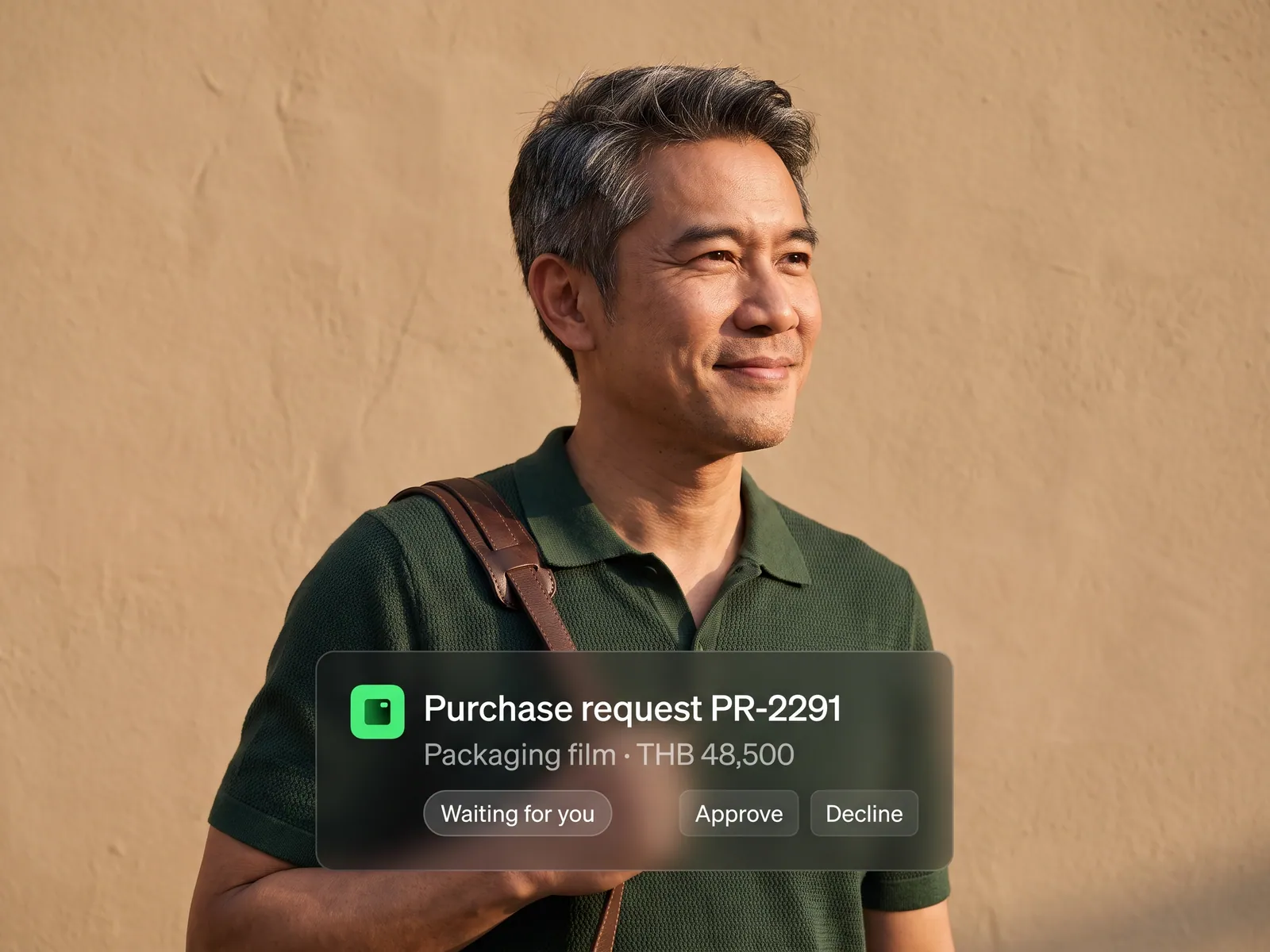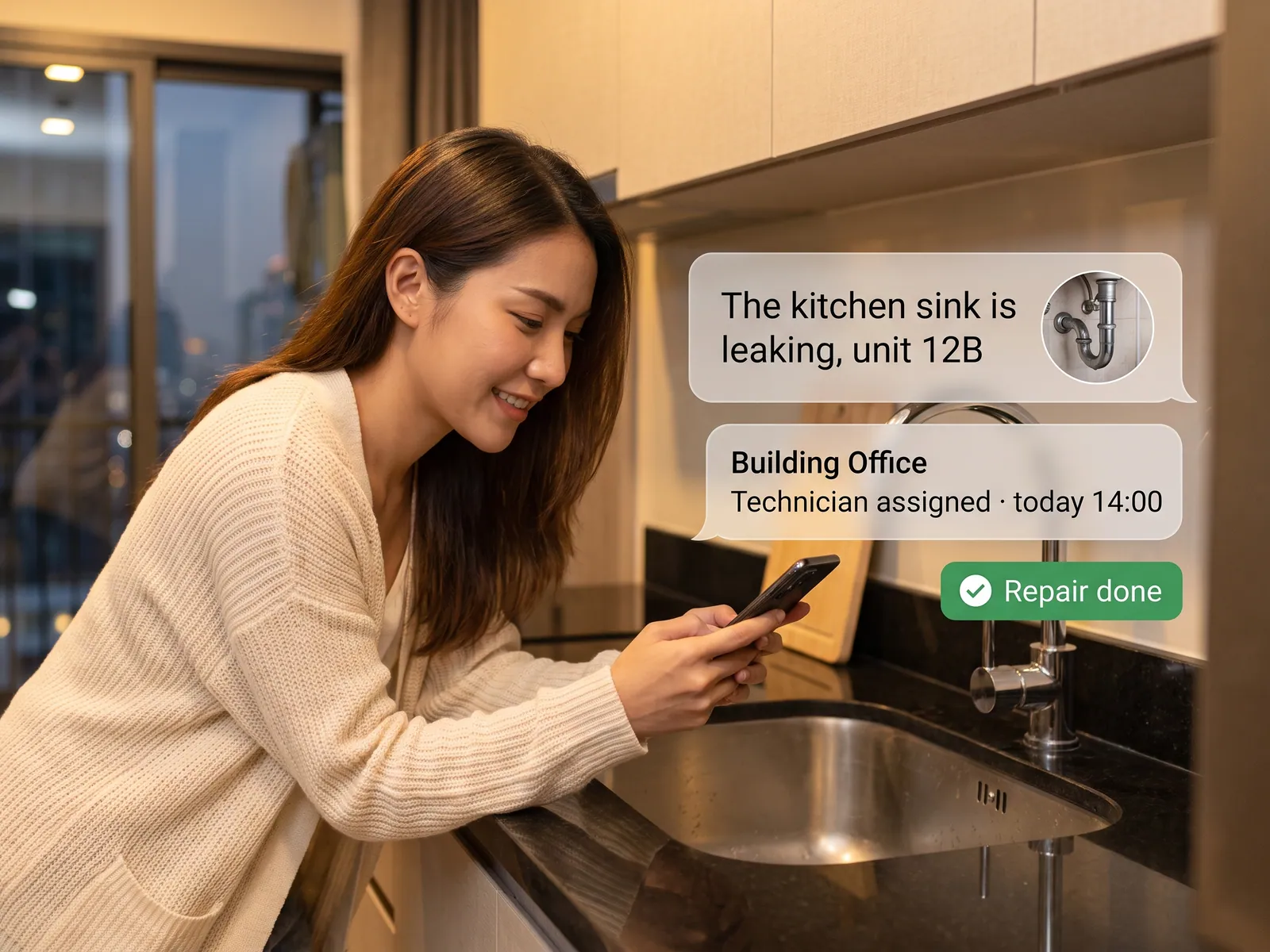
Less spent on paper and storage, and a daily view of what was issued and what awaits approval. The Cabinet has also approved extending the tax deduction for the cost of electronic tax systems; your tax adviser can check whether you qualify.
Back to AI Workflow
Accounting teams issuing many invoices · 07 / 14
e-Tax Invoice and e-Receipt workflow
Tax invoices and receipts leave your POS or ERP in the Revenue Department’s format and reach customers by email or LINE at once, with nothing for accounting to print or key in twice.
 Accounting teams issuing many invoices
 “Customers message us on LINE every day asking for a full tax invoice. The team digs the bill out of the POS and keys it in again, one at a time. A wrong tax ID means cancelling and reissuing, and the paper copies have already filled the storeroom.”
The problem
Most businesses that issue hundreds of bills a day still do it the old way. The POS prints an abbreviated receipt, and the ERP prints a full tax invoice or makes a PDF that someone attaches to an email, one at a time. When a corporate customer wants a full tax invoice, they send a photo of the receipt and their company name on LINE. Someone in accounting finds the original bill, keys the buyer’s details into another system and sends it back. These requests come in every day, and plenty come twice because the customer lost the first one.
Corrections take the most time. One wrong digit in a tax ID or a missing branch means cancelling the original and issuing a new one. A returned item needs a credit note. Every step is manual and tracked in Excel, the paper copies have to be kept for years, and at month-end the team reconciles the output VAT report against the POS and the ERP before filing the PP.30 return.
How we solve it
We connect the POS, ERP or online-store back office you already use to the issuing system. Every closed sale becomes a tax invoice or receipt in the format the Revenue Department sets, and goes on to the customer. The RD offers two routes. With e-Tax Invoice & e-Receipt, the company signs documents digitally with an electronic certificate and sends the XML data to the RD by the 15th of the following month, either directly or through a service provider on the RD’s list. With the Time Stamp route, the tax invoice is emailed to the customer and to ETDA’s time-stamping system at the same time. We help you pick the route that suits your document volume.
A customer holding a shop receipt scans the QR code at the bottom, enters the company name, tax ID and branch, and gets a full tax invoice by email without messaging anyone. The new invoice is tied to the original bill, so the same bill can’t be claimed twice. Before any document goes out, the system checks the 13-digit tax ID, the branch code, the total and the VAT against the line items. The RD’s system checks file structure and signatures, and the figures are the issuer’s responsibility. If the RD reports a failed submission, the document appears on the dashboard with the reason, ready to fix and resend.
Anything that changes the tax owed, whether a credit note, a debit note or a cancel-and-reissue, stays an accountant’s decision. The system prepares the document with the reason and the original bill, sends it for approval in LINE or the back office, and issues nothing until someone approves. Every correction is recorded as a new entry that shows before and after, and nothing is deleted. If you pay for services through your bank’s e-Withholding Tax service, the system adds the withholding tax details to the payment file. The bank withholds and remits the tax, so you don’t issue 50 Tawi certificates.
How it runs
Work comes in from
- Bills from the shop POS
- Invoices and delivery notes from the ERP
- Orders from the online-store back office
- Full-invoice requests via the receipt QR
What the AI does
- Build documents in the RD’s format
- Check tax ID, branch and totals
- Get credit notes and cancellations approved
- File with the RD and track the result
Where it lands
- Customer’s email or LINE
- Revenue Department e-Tax system
- Accountant in LINE or the back office
- Dashboard and PP.30 summary
Before and after
Before
After
Customers ask for a full tax invoice on LINE, and staff rekey each one
Customers scan the receipt QR and get a full tax invoice by email themselves
A wrong tax ID surfaces when the customer sends the document back
Documents with missing or wrong details are held for a fix before they go out
A room full of paper copies, and output VAT reconciled by hand at month-end
Every document is a searchable file, and the VAT summary is ready as the month starts
What you get
- 01
Tax invoices, receipts, debit notes and credit notes issued from your POS, ERP or online-store back office in the Revenue Department’s format, filed directly or through a provider on the RD’s list
- 02
Documents delivered by email or LINE as soon as the customer pays, and a QR code on the receipt where customers enter their tax ID and get a full tax invoice themselves
- 03
Credit notes, debit notes and cancellations run as a workflow, and an accountant approves each one in LINE or the back office before it is issued
- 04
A pre-submission check that catches missing tax IDs, wrong branch codes, totals or VAT that don’t match the lines, and duplicate numbers, and holds the document for a person to fix
- 05
A dashboard of what was issued, delivered, rejected by the RD or awaiting approval, with a monthly summary for the VAT return
Who gets what
Connects to the POS and ERP through their API or existing exports, with no change to the sales system. The XML follows ETDA’s e-Tax standard, the company certificate stays on its USB token or HSM, and every edit is logged as the Revenue Department requires of issuing systems.
Accountants stop reprinting bills and answering tax-invoice requests in chat. They handle only the documents the system held back and the requests waiting for approval, and the VAT summary is already there at month-end.
Who this fits
Retail & franchisesDistributors & B2B suppliersClinics & hospitalsSchools & collegesUtilities & property
Connects with what you already run
Existing POSSAP Business OneExpressPEAKLINE OACompany emailRevenue Department e-Tax system
Development process
- 1
Discover
Requirements, users and success metrics, with scope and price fixed before we start.
- 2
Design
UX and system architecture; the prototype is approved before anything is built.
- 3
Build
AI-accelerated sprints with a demo every week, reviewed by senior engineers.
- 4
Test
QA, security and performance verified against the agreed scope.
- 5
Launch & care
Production deploy, team training, and a monthly care plan.

Turn your business problem into a system that works for you
Tell us today — get an executive-ready proposal with the plan and budget.
Talk to an engineer about thisMore solutions in AI Workflow
See the whole service Marketing teams Marketing workflow Sales teams Sales and CRM workflow Accounting & finance teams Accounting and finance workflow HR teams Employee onboarding workflow Purchasing teams Purchase request and approval workflow Customer service teams Customer service workflow Brands selling on marketplaces Marketplace back-office workflow Factories & manufacturers Purchasing and goods-receipt workflow Accounting & law firms Client document workflow Hospitals & clinics Insurance claim and records workflow Logistics & transport Job sheet and billing workflow Real estate & juristic offices Repair request and common-fee workflow Wholesalers & distributors Orders-from-chat workflow