

- Most companies test something new only a few times a year, because every idea has to become a big project before it gets a budget.
- Make each experiment cheaper and the number of experiments you can run goes up by itself.
- Agree first on the criteria for what passes and what should stop, so the decision doesn't turn political.
1. From a few big projects a year to continuous experimentation
If every idea in your company has to win a large budget approval before it can be tested, you'll test two or three a year, and each one will be so expensive that nobody dares say it isn't working. The problem is rarely a shortage of ideas. What's missing is a path for those ideas to travel.
Traditional companies pool budget and people to build a handful of products, because every piece of research and every prototype is expensive. AI helps summarize what customers are saying, generate options, simulate experiences, and produce images and sales pages, so a company can buy knowledge from the market more often without growing the team for every new idea.
For the development team · Technical detail
The goal is to raise the number of “hypotheses answered” each month. Launching lots of full products is beside the point. A good factory takes customer problems as its input, runs them through stage gates and produces Learn, Kill, Pivot or Scale as its output.
2. Design a five-stage innovation funnel
The fix is to give every idea clear gates that spell out what evidence it must show to move on. When the criteria are clear, stopping an idea is no longer about who wins or loses. It becomes a decision based on the data.
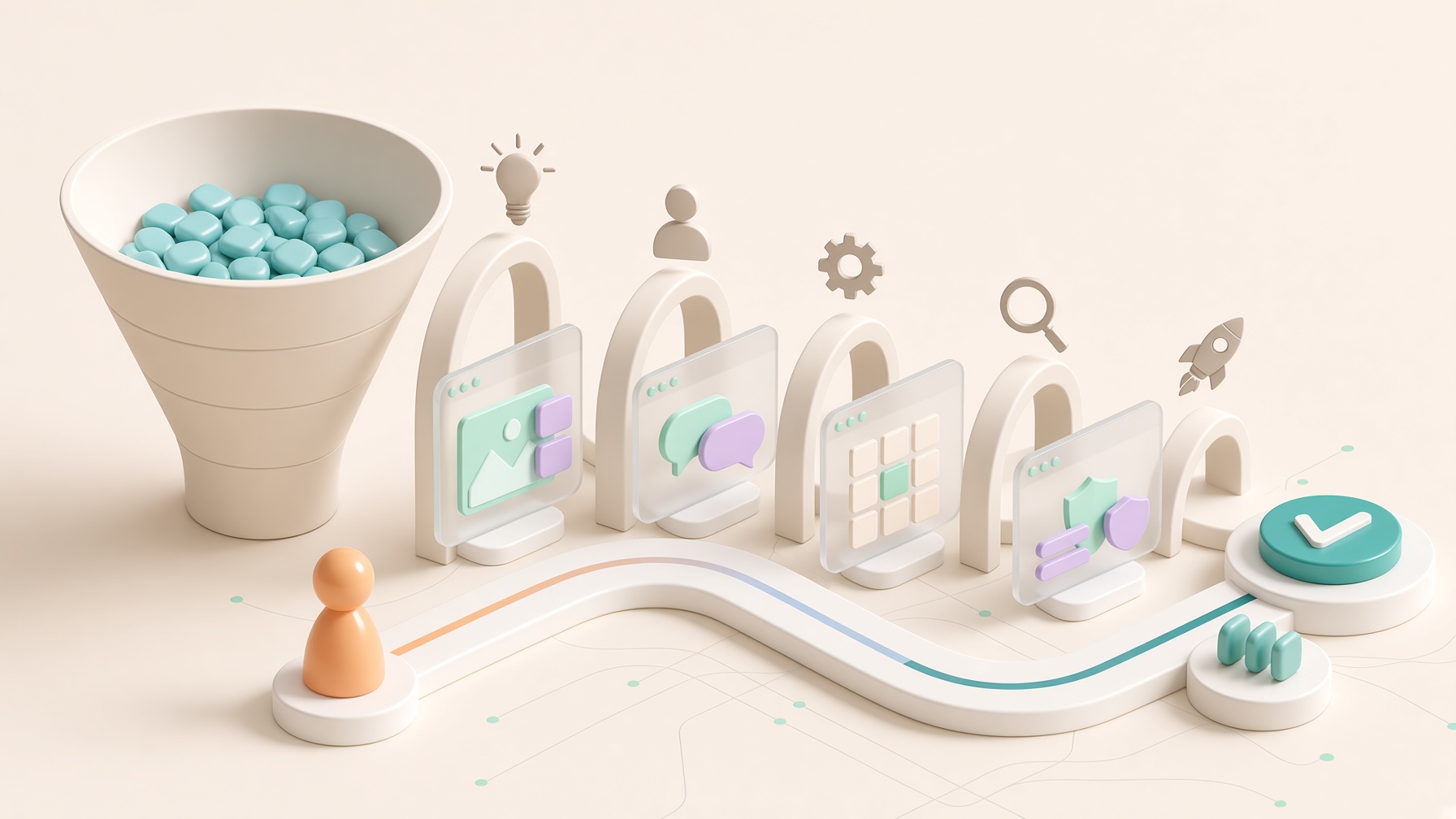
| Stage | Question | Evidence to pass the gate |
|---|---|---|
| Signal | Is there a real problem or opportunity? | Repeated behavior or complaints |
| Problem | Does it matter, and who has the budget? | Interviews + the cost of the problem |
| Offer | Which offer attracts interest? | Meetings booked, trials, contact details left |
| Solution | Can it deliver the outcome? | Prototype + outcome |
| Scale | Are the economics and repeat use healthy? | Unit economics + retention |
Set a budget and a time limit for each gate. Many ideas should be stopped in the early stages. That is the system working as designed, and nobody should read it as failure. Don't let the person who proposed an idea be its only judge. Use criteria agreed before anyone sees the results.
3. Build an engine that finds opportunities in real data
For the development team · Technical detail
Combine support tickets, sales calls, searches, reviews, return reasons and external trends. AI can help cluster them, track how they change over time and pull out example quotes, but the team has to check the sources and how representative they are, so the voice of one large customer doesn't drown out the market.
For the development team · Technical detail
Build an opportunity backlog that records segment, frequency, severity, existing solution, strategic fit and evidence owner. Each month, the team picks problems by score instead of starting from a blank brainstorm. Give employees a way to submit signals along with their evidence.
Separate trends from needs. A new technology may be interesting and still have no job-to-be-done. Use AI to explore what is possible once a problem has passed its gate. Don't build a product just to find a reason to use AI.
4. A prototype factory that matches fidelity to the question
For the development team · Technical detail
Test messaging and pricing with a landing page, steps with a clickable prototype, outcomes with a concierge service, and physical products with a mockup or a small batch. Don't build a full system to test whether customers are interested. AI can generate variants, but limit them to the number of options the team can actually review.
For the development team · Technical detail
Build a component library: research templates, value propositions, brand rules, a design system, landing pages, surveys and analytics. Every experiment uses the same standards, which cuts setup time and makes the results comparable.
5. Test for commitment, not compliments
Define behaviors that cost the user something, such as booking time, sending information, trying it on real work, paying a deposit or placing a pre-order. Answers like “interesting” carry little weight. Separate acquisition tests from value tests, because ads can pull in clicks for a product that still fails to deliver results.

Use cohorts and segments, and don't lump together results from different customer groups. Set the criteria before you run the test, for example at least 8 meetings booked out of 50 targets, or 30 percent of users coming back within two weeks. Record the reasons for rejection and the cost of delivering manually.
After the test, AI can help summarize the patterns, but the Product Owner decides on Kill, Pivot or Scale and states the reasons. Keep a decision log so the team doesn't test the same idea again when people change.
6. The economics of an idea portfolio
Allocate 70 percent of the budget to core improvement, 20 percent to adjacent opportunities and 10 percent to transformative bets. Release money in investment tranches, adding budget as the evidence gets stronger, instead of approving the full budget at the concept stage.
For the development team · Technical metrics
Measure cost per experiment, time to evidence, kill rate, experiment-to-scale and profit from new products. A low kill rate may mean the gates are weak, rather than that the team is right about every idea. A high number of experiments with no products reaching scale shows the system is stuck in a bottleneck after the prototype stage.
7. Governance that doesn't kill speed
Sort experiments into risk tiers. Testing messaging internally needs only light approval, but anything that touches health, finance, personal data or guarantees needs a specialist. Don't impose a production checklist on a prototype that has no real customers. At the same time, fake claims and using data without permission must stay off limits.
Create a safe sandbox with synthetic data and approved tools, so teams can experiment quickly inside the guardrails. The IP of whatever is created, source licenses and customer data must be recorded from the start, so if the idea gets a chance to scale you won't have to go back and rebuild its whole legal basis.
8. Build an innovation factory in 90 days
- Days 1 to 15: gather signals and define the funnel and its gates
- Days 16 to 30: build templates, components and an experiment dashboard
- Days 31 to 60: run sprints on 3 to 5 ideas with real customers
- Days 61 to 75: analyze the bottlenecks and adjust the gates and the team
- Days 76 to 90: move one idea into scale validation and set up a monthly cycle
In short: AI makes prototyping cheaper, but companies gain the advantage when they turn that speed into a learning loop. Build a signal engine, stage gates, a prototype factory and measurement that rewards evidence over volume. A good innovation factory produces new products and also the ability to stop unprofitable ideas quickly.
Make testing new ideas cheap enough to do every month
The ideas worth testing come from the people who work with customers and on the front line, and a software team is rarely their source. What we often find is that a company has plenty of ideas but no path for them to travel, so everything has to become a big project before it gets a budget. DNA Maker helps put a system in place by defining the stages of the funnel clearly: what evidence each stage needs before an idea moves on, who decides and the maximum time it may take. That clarity takes the politics out of stopping an idea and turns it into a decision made against agreed criteria.
A structure for fast experiments without losing control
On the tools side, we build things that bring down the cost of each experiment, such as a prototype kit that can be reassembled, landing pages that measure real interest, and a system that keeps all test results in one place so ideas can be compared. We use AI to speed up analysis, draft prototypes and write the first round of code, and engineers always review it before anything goes into production. If your organization has several ideas stuck in meetings that nobody has had the chance to test, we can help design a first round of experiments and make it happen.
SOFTWARE ENGINEERING GLOSSARY
Software engineering glossary
These terms help when you discuss how to test products quickly and in a measurable way.
| Term | What it is | A simple example | What executives should ask the development team |
|---|---|---|---|
| Prototype | An early model for testing an idea, before it becomes a working production system | A mock-up screen customers try out to see whether they understand it | Which hypothesis does this prototype test, and how will we know if it fails? |
| MVP | The smallest product that can prove its value with real customers | Launching a service in just one city to measure demand | What can we cut while still proving the value? |
| Feature Flag | A switch that turns a feature on or off without releasing a new version | Turning a new feature on for a small group of customers first | If the feature causes problems, how quickly can we switch it off, and who does it? |
| A/B Test | Comparing two approaches with similar groups of users to see which works better | Testing two versions of a message on the same page | Is the difference we see significant enough to base a decision on? |
| Backlog | A prioritized list of work or ideas waiting to be done | Screened ideas waiting for the next round of testing | Who prioritizes the backlog, and on what criteria? |