
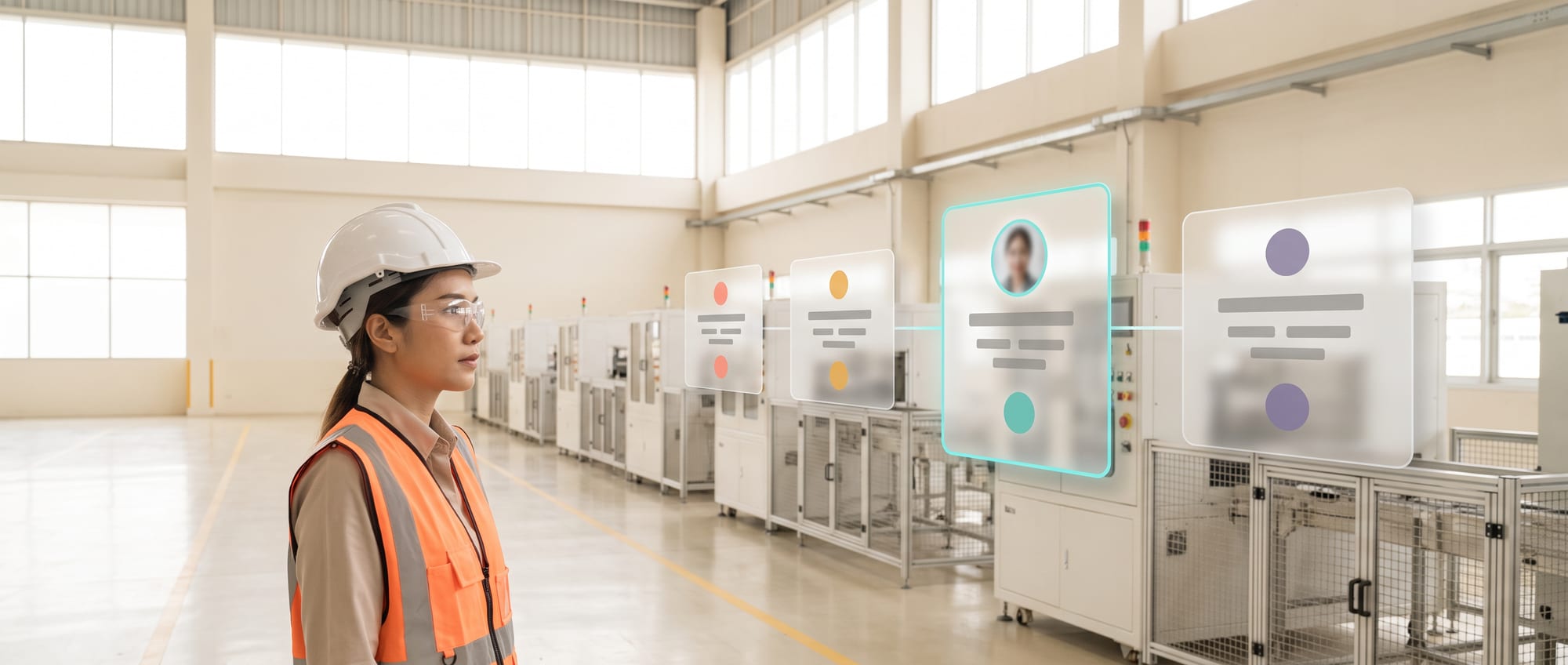
- Don't start by asking “Where can we use AI?” Start with “What cost us the most money this month?”
- A safe starting point is one you can trial without stopping the production line and can measure clearly within a few weeks.
- The trial team must always include people from the shop floor, because they know what really works and what only looks good on paper.
Build a loss map before a technology roadmap
The first question to ask is “What did our factory lose the most money on last month?” Was it machine stoppages, scrap, rework or waiting for changeovers? “Where should we put the cameras?” can wait. Once you know that number, where to start usually becomes obvious.
For the development team · Technical detail
Gather downtime, scrap, rework, changeover, energy, WIP and customer claims, broken down by line, product, shift and machine, then calculate the value of the losses using a formula Finance accepts. Problems that are frequent and expensive are where you start. The spots where cameras are easy to install, or where a vendor has a slick demo, are the wrong reason to choose.
Score use cases on value, frequency, data readiness, whether they can be trialed without stopping production, and safety risk. Good candidates have a clear end user, such as a technician who has to decide what to inspect or a QC inspector who has to choose which parts to pull. A broad project labeled “build a Smart Factory” doesn't qualify.
Order projects from low risk to high
A good starting point is one where nobody is hurt if the trial fails: you don't have to stop the line, deliveries aren't affected and you know the result within a few weeks. The spot where the vendor says the demo looks best is often a poor choice.

| Order | Use case | Reason |
|---|---|---|
| 1 | Searching manuals and summarizing shifts | Helps people without controlling machines |
| 2 | Vision that flags suspect points | QC still makes the call and feedback is collected |
| 3 | Anomaly detection and maintenance | Gives more planning time before a breakdown |
| 4 | Production and energy planning | Builds scenarios within real constraints |
| 5 | Closed-loop Control | Needs the strongest evidence and the highest safety standards |
For the development team · Technical detail
Start in shadow mode, with AI making recommendations alongside the existing method. Record false alarms and missed events across several shifts, several lots and changeover periods before the results are allowed to influence production. You need a manual override, interlocks and standard work for when data is missing or the system goes down.
The pilot team must include the people who will use the results
For the development team · Technical detail
The loss owner, operators, maintenance or QC, process engineers, IT/OT, safety and finance must set the criteria together. A vendor or data team shouldn't define success on the shop floor's behalf. Build a test set with normal cases, edge cases and abnormal events, and define which kinds of recommendation lead to an inspection, a recheck or a stop.
Examples of a pilot with controlled scope
Instead of “reduce factory downtime,” choose “flag bearing anomalies on Group A motors early enough to schedule an inspection.” Instead of “inspect all defects,” choose “check for type X blemishes on SKU Y after the assembly point.” A narrow scope makes it faster to find the data, measure the results and learn the limitations.
Gates before go-live
- Safety and cybersecurity reviews have been passed
- Operators understand the warnings and how to override them
- Both false alarms and missed events are counted
- There are owners for incidents and for model changes
- The manual system works when the AI stops
Pay back and scale without creating a pilot cemetery
For the development team · Technical detail
Include the costs of sensors, edge devices, network, integration, labeling, cloud, support, shop-floor time and model maintenance. Compare cost per outcome instead of relying on accuracy alone. The benefit is the loss actually reduced multiplied by the share AI is responsible for. Claiming the entire value of downtime overstates it.
For the development team · Technical detail
When a pilot passes, set standards for data tags, interfaces, alerts, training, change control and support before expanding to the next line. Check site differences such as lighting, older machine models, raw materials and night-shift skills. If almost everything has to be redone, you are looking at a new project, and calling it scaling hides that.
The portfolio should get a decision every quarter: Scale, Improve, Hold or Stop. Projects that don't pay off should be stopped and their lessons kept. The most advanced factory is the one that safely turns measurable losses into new working standards, whatever its number of pilots.
SHOP-FLOOR TIP · Start from losses, not toys
A pilot canvas you can fill in with a pen in 20 minutes
Draw six boxes: the loss to reduce, the decision that needs to improve, who uses the result, the data available, how to trial it without risk, and the value formula. If any box is empty, don't call a vendor in yet, because the technology will end up defining the problem for the team.

The 1-1-1-1 rule
One line, one shift, one loss and one owner in the early phase. Expand once you have been through a full production season or an important change in product mix. Don't multiply one week's results across a whole year without deducting downtime, maintenance and the time people spend looking after the system.
Tip: Invite operators from the shift where the system is hardest to use onto the pilot team from day one. If the system only works while an engineer is standing next to it, it isn't ready to be called a production system.
From knowledge to a working system that solves the problem
The underlying problem
A factory should buy the ability to reduce losses, and the label “AI” is beside the point. A good pilot has to be tied to one decision that the shop floor can make better.
A step-by-step approach
- Build a loss map and rank use cases by value, feasibility and risk
- Survey the data and OT systems, and design a shadow mode that doesn't affect safety
- Prove the results on one line, then set standards before expanding
Build the software layer that connects shop-floor knowledge with factory data
DNA Maker doesn't step in to replace the factory's process engineers, operators, quality team or safety staff. They know best where losses occur, which signals matter and which decisions are safe. Our role is to help frame the questions, build a Loss-to-Decision Map and design data collection so that shop-floor knowledge connects to real events. We help sort out which problems should start with forms and workflows, which need integration and which should use AI later, so the factory doesn't invest in technology before it knows what users will do with the results.
When the problem suits software, DNA Maker can build web or mobile applications for shop-floor logging, dashboards, alert workflows, Knowledge Assistants or AI Agents that gather data and coordinate with existing systems, including connecting IoT, MES or CMMS through an architecture agreed with the client's technical team. We help run shadow pilots, design UX for production shifts, and build the systems and monitoring, with the factory's safety rules treated as requirements. If you have a loss you want to reduce but aren't sure whether to start with sensors, process or software, we're ready to talk through a pilot that answers that question with evidence.
SOFTWARE ENGINEERING GLOSSARY
Software engineering glossary
This table isn't meant for memorizing. It helps executives, the people who own the work and the development team talk to each other without reading the same words differently. Read the meaning, the example and the question on the right, because those questions often expose hidden scope, risks and costs before development starts.
| Term | What it is | A simple example | What to ask the development team |
|---|---|---|---|
| Edge Computing | Processing data close to the machines instead of sending everything to the cloud | Analyzing images at the line to reduce delay | Which tasks need an instant response, and why do they have to be processed on the shop floor? |
| IoT | Devices or sensors that send data over a network | Reading a machine's temperature every minute | Who owns each sensor, and how is it checked and calibrated? |
| Data Pipeline | The path data takes from its source to where it is used | Sensor → database → dashboard | How does the system cope when data is missing or arrives late? |
| Shadow Mode | Letting the system make recommendations without yet controlling real work | Comparing alerts with the technicians' own decisions | How long, and through which conditions, must it be trialed before real use? |
| Integration | Connecting a new system with the factory's existing systems | Sending events into the CMMS or MES | What is the data contract between the systems, and who looks after each side? |